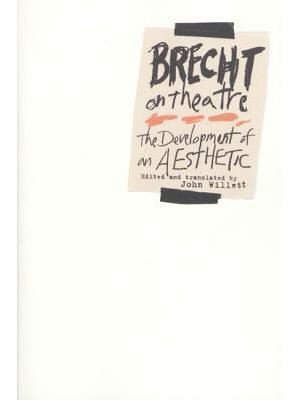
Brecht on Theatre: The Development of an Aesthetic

Brecht on Theatre: The Development of an Aesthetic

PAPERBACK

01 Jan, 1964

By Bertolt Brecht (author), Steve Giles (Edited by), John Willett (Translated by)

This volume offers a major selection of Bertolt Brecht's groundbreaking critical writing. Here, arranged in chronological order, are essays from 1918 to 19...

Ships within 15-17 Business Days

New

₹ 1611
₹ 1352
BRAND NEW - Item in perfectly NEW condition.

Used

-
GOOD CONDITION - Used book in GOOD - READABLE condition. The books may contain markings, highlightings and wear due to previous usage. The book is in overall good condition. Great Deal !!!

Last updated on 22 Feb, 2026

ISBN-10:

0809005425

ISBN-13:

9780809005420

Publisher

Farrar, Straus and Giroux

Dimensions

8.06 X 5.36 X 1.00 inches

Language

English

Description

This volume offers a major selection of Bertolt Brecht's groundbreaking critical writing. Here, arranged in chronological order, are essays from 1918 to 1956, in which Brecht explores his definition of the Epic Theatre and his theory of alienation-effects in directing, acting, and writing, and discusses, among other works, The Threepenny Opera, Mahagonny, Mother Courage, Puntila, and Galileo. Also included is "A Short Organum for the Theatre," Brecht's most complete exposition of his revolutionary philosophy of drama.

Translated and edited by John Willett, Brecht on Theater is essential to an understanding of one of the twentieth century's most influential dramatists.

Product Details

ISBN-10

:0809005425

ISBN-13

:9780809005420

Publisher

:Farrar, Straus and Giroux

Publication date

: 01 Jan, 1964

Category

: Literary Criticism

Sub-Category

: Drama

Format

:PAPERBACK

Language

:English

Reading Level

: All

No. of Units

:1

Dimension

: 8.06 X 5.36 X 1.00 inches

Weight

:296 g

About the Author

Bertolt Bertolt (1898-1956) was the most influential German dramatist and theoretician of the theater in the 20th century. Also a poet of formidable gifts and considerable output, Brecht first attracted attention in the Berlin of the 1920s as the author of provocative plays that challenged the tenets of traditional theater. Forced to flee Germany in 1933 because of his leftist political beliefs and opposition to the Nazi regime of Adolf Hitler, Brecht and his family spent 14 years in exile in Scandinavia and the United States. Although he tried hard to become established in the United States, Brecht failed to make a breakthrough either as a scriptwriter in Hollywood, California, or as a playwright on Broadway. Two years later he moved to East Berlin and remained there until his death. In the 1950s he became an internationally acclaimed playwright and director through productions of his plays by the Berliner Ensemble, a company based in East Berlin and headed by his wife, actor Helene Weigel.

John Willett (1917-2002) was a noted scholar, author and translator. From the outset he was the prime editor and translator (with Ralph Manheim and others) behind Brecht in English. He was involved in the planning and translation of the programme book for the Berliner Ensemble's celebrated first visit to London in 1956 (the year of Brecht's own death); in 1959 he published the first general study in any language, The Theatre of Bertolt Brecht; he translated, edited and introduced the enormously influential Brecht on Theatre (1964); and he was a founding member of the International Brecht Society and sometime editor of its Yearbook.

Loading, please wait...

Copyright © 2026. Boganto.com. All Rights Reserved