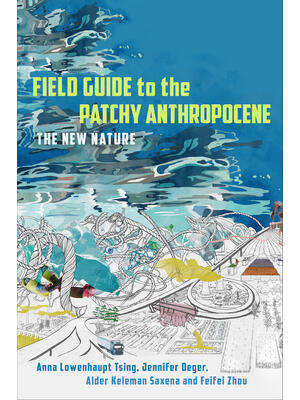
Field Guide to the Patchy Anthropocene: The New Nature

Field Guide to the Patchy Anthropocene: The New Nature

Hardcover

07 May, 2024

By Anna Lowenhaupt Tsing (author), Jennifer Deger (author), Alder Keleman Saxena (author)

Nature has gone feral. How can we re-attune ourselves to the new nature? A field guide can help. While the global scientific community recently made headli...

International Edition

Ships within 15-17 Business Days

New

₹ 2850
₹ 2479
BRAND NEW - Item in perfectly NEW condition.

Used

-
GOOD CONDITION - Used book in GOOD - READABLE condition. The books may contain markings, highlightings and wear due to previous usage. The book is in overall good condition. Great Deal !!!

Last updated on 22 Feb, 2026

ISBN-10:

1503637328

ISBN-13:

9781503637320

Publisher

Stanford University Press

Dimensions

9.10 X 5.90 X 1.20 inches

Language

English

Description

Nature has gone feral. How can we re-attune ourselves to the new nature? A field guide can help.

While the global scientific community recently made headlines by ruling the Anthropocene--an era many date to the Industrial Revolution when human action truly began to transform the planet--did not qualify for a geological epoch quite yet, understanding the nature of human transformation of the Earth is more important than ever. The effects of human activity are global in scope, but take shape within distinct social and ecological "patches," discontinuous regions within which the key actors may not be human, but the plants, animals, fungi, viruses, plastics, and chemicals creating our new world. Field Guide to the Patchy Anthropocene takes stock of our current planetary crisis, leading readers through a series of sites, thought experiments, and genre-stretching descriptive practices to nurture a revitalized natural history.

Field guides teach us how to notice, name, and so better appreciate more-than-human worlds. They hone our powers of observation and teach us to see the world anew. Field-based observations and place-based knowledge cultivation--getting up-close and personal with patchy dynamics--are vital to truly grapple with the ecological challenges and the historical conjunctures that are bringing us to multiple catastrophic tipping points. How has commercial agriculture runoff given rise to comb jellies in the Black Sea? What role did the Atlantic slave trade play in the worldwide spread of virus-carrying mosquitoes? How did the green revolution transform the brown planthopper into a superpredator in Philippine rice fields? Questions like these open up new ways of understanding, and ways of living through, the epoch that human activity has ushered in.

This Field Guide shifts attention away from knowledge extractive practices of globalization to encourage skilled observers of many stripes to pursue their commitments to place, social justice, and multispecies community. It is through attention to the beings, places, ecologies, and histories of the Anthropocene that we can reignite curiosity, wonder, and care for our damaged planet.

Product Details

ISBN-10

:1503637328

ISBN-13

:9781503637320

Publisher

:Stanford University Press

Publication date

: 07 May, 2024

Category

: Social Science

Format

:Hardcover

Language

:English

Reading Level

: All

No. of Units

:1

Dimension

: 9.10 X 5.90 X 1.20 inches

Weight

:691 g

Editorial Reviews

"Field Guide to the Patchy Anthropocene is poetic, playful, and unendingly curious. Its pages abound with unexpected stories and characters, inspiring readers to explore emergent patches for themselves. A timely call to rethink the scales and temporalities of ecological disruption, and a tool for building a new critical lexicon." --Kregg Hetherington, author of The Government of Beans: Regulating Life in the Age of Monocrops

About the Author

Anna Lowenhaupt Tsing is Distinguished Professor of Anthropology at the University of California, Santa Cruz and the author of The Mushroom at the End of the World. She is also a Professor at Aarhus University. Jennifer Deger is Professor of Digital Humanities and Co-Director of the Centre for Creative Futures at Charles Darwin University, Australia. Alder Keleman Saxena is Assistant Professor in the Department of Anthropology and Program in Sustainable Communities at Northern Arizona University. Feifei Zhou is Adjunct Assistant Professor in Architecture at Columbia University Graduate School of Architecture, Planning and Preservation. Together they are coeditors of Stanford's digital publication Feral Atlas: The More-than Human Anthropocene (2020).

Loading, please wait...

Copyright © 2026. Boganto.com. All Rights Reserved