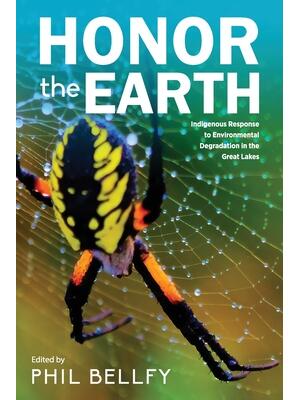
"Let's not beat around the bush, we are in trouble! This book provides some very important perspectives from an Indigenous lens about the condition of the Mother Earth and our behaviors as humans." --Martin Reinhardt, Professor of Native American Studies at Northern Michigan University.
"This book of updated essays grew out of an environmental conference at MSU on Earth Day, 2007. The essays, as the subtitle suggests, are responses by Native Americans to the miserable record of pollution, overconsumption of natural resources, and the all too evident triumph of greed over maintaining a livable environment in the Great Lakes and the world. Readers should not be put off by what appears, at first glance, to be a book intended for a scholarly audience. Yes, the format, extended bibliographies, and chapter headings such as, "Grassroots Indigenous Epistemologies: Native, Non-Governmental Organizations, and the Environment," are a little off-putting. Don't be.
At the heart of most of the essays is the difference between Indigenous Peoples' attitude to the earth and environment which is best summarized by living in balance with nature as opposed to modern society's exploitation of the environment. The essays address a wide range of environmental concerns and the writing is often sharp, critical, and outraged. One essay I found especially interesting and biting was on overpopulation and how Japan is so overpopulated many of her people are "literally tumbling into the sea." Yet they are worried that their declining birthrate means in the future they will have fewer workers to "produce, ' and thus 'consume' whatever it is that's produced." The author then goes on to say, "Think about it. I suggest that this attitude signifies nothing so much as stark, staring madness. It is insane: suicidally, homicidally, ecocidally, homicidally insane."
The book is a deep dive into indigenous culture, beliefs, and their close relationship to nature and the environment. It is provocative, disturbing, and to the point. And the point is that humanity is "killing the natural world, and thus itself. It's no more complicated than that." -- Tom Powers, Michigan in Books
"Honor the Earth has a wide variety of essays covering a range of topics, such as Traditional Knowledge, Indigenous Responsibility, the threats of mining, capitalist schemes, and much more. One powerful aspect of this book is its power. As a non-Native reader, I know I will never be able to truly comprehend how destructive Western colonization and capitalist incentives have been to Native communities. The most disturbing, stark realities revealed in Honor the Earth, was the effect of mining and pollution of lake waters on surrounding communities. I had never heard of having limits on how much fish someone, such as a pregnant woman or a woman who wished to bear children in the future, could consume as a result of the dangerous toxins that those fish were exposed to, and therefore ingested and became contaminated with. The idea that these communities cannot go through daily life without clean, safe food and even water, in this day and age, is a reminder of how those of more privileged status seem to continually write off the struggles and dangers that those in lower economic classes are being forced to face. Honor the Earth is a hard pill to swallow as a non-Native, white reader, but it is a necessary pill. I cannot pretend to understand the nuances of nature and the land around me like Native populations can, because they have poured their blood into it thousands of years longer. We cannot contend to understand the traditional ecological knowledge of the Native populations, but we can be allies. Honor the Earth is a powerful collection that would be a great addition to the bookshelves of those interested in ecology, anthropology, cultural studies and indigenous studies." -- Megan Weiss, Reader Views