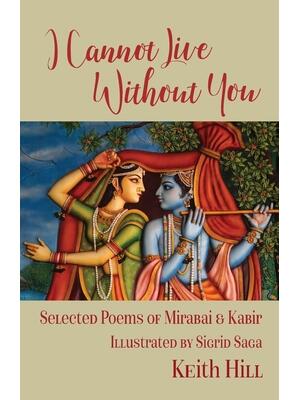
I Cannot Live Without You : Selected Poems of Mirabai and Kabir

I Cannot Live Without You : Selected Poems of Mirabai and Kabir

PAPERBACK

11 Jan, 2021

By Keith Hill (author)

Wild and passionate, Mirabai is Indiaís greatest poet of devotion and love. Married at a young age, after her husbandís premature death she dedicated her...

Ships within 15-17 Business Days

New

₹ 1239
₹ 994
BRAND NEW - Item in perfectly NEW condition.

Used

-
GOOD CONDITION - Used book in GOOD - READABLE condition. The books may contain markings, highlightings and wear due to previous usage. The book is in overall good condition. Great Deal !!!

Last updated on 12 Jan, 2026

ISBN-10:

0995133336

ISBN-13:

9780995133334

Publisher

Attar Books

Dimensions

8.50 X 5.50 X 0.29 inches

Language

English

Description

Wild and passionate, Mirabai is Indiaís greatest poet of devotion and love. Married at a young age, after her husbandís premature death she dedicated her life to worshipping the flute-playing Krishna. It was a decision that led her parents-in-law to evict her from their home. Mirabai spent the rest of her life travelling from village to village, singing and dancing to celebrate her love of Krishna. The rapturous lyrics she wrote enthralled worshippers then and continue to be sung in India today.

Kabir was a controversial figure. An illiterate weaver, Kabir celebrated both Indian and Muslim spirituality, while criticising each religionís blinkered believers. Yet his straight talking, his wit, and the continued relevance of his cutting insights, ensure his often knotty poems still resonate powerfully for contemporary readers.

Superbly translated into English-language poems that reflect their original imagery and forms, this collection shows why Mirabai and Kabir have enchanted devotees for five centuries. Their poems are accompanied by new versions of two of the key Upanishads that laid the foundations for Indian spirituality. These engaging versions will delight readers new to the work of two of Indiaís greatest mystical poets, and surprise those already familiar with their playful profundity.


MIRABAI: I SHALL DANCE


I shall dance in the presence of Krishna, my lord.

Purely to please, my bare feet will caress the floor.


So solemn and enticing, I shan't be ignored,

and as I turn, closer-to examine him-will I draw.


Yes, love's tied bells to my ankles, tinkling, so small.

And who knows? Perhaps, as I dance, all my veils will fall.


What do I care for customs and the world's joyless laws?

When he arrives, I shall silently close the door.


Yes, Mira will share her lover's bed, embraced and warm.

They'll laugh and sip love's wine-she knows she won't be bored!


KABIR: ON THE COMPETENT GURU


No competent gurus nor pupils I found,

just players of greedy games.

All sank in maya's sea,

for they sailed boats made of stone.


I say, cut off that guru's beard whose

teaching doesn't scythe doubt,

for not only does he sink but

he drags his pupils down.


An incompetent guru means

the pupil is incapable:

grasping pupil, profit-seeking guru,

and both are in trouble.


Without a competent guru

you'll remain an illiterate fool.

Dress like a saint, inside you're an idiot

begging from door to door.


Product Details

ISBN-10

:0995133336

ISBN-13

:9780995133334

Publisher

:Attar Books

Publication date

: 11 Jan, 2021

Sub-Category

: Asian - Indic

Format

:PAPERBACK

Language

:English

Reading Level

: All

Dimension

: 8.50 X 5.50 X 0.29 inches

Weight

:164 g

Editorial Reviews

Indian spirituality with its richness and wisdom is the sustaining score of I Cannot Live Without You. A tripartite structure is created as two sixteenth century poets, Mirabai and Kabir, speak on either side of the two sacred Upanishads, Ishavashyopanishad and the Kenopanishad, found in the middle of the book. Reading these three parts of I Cannot Live Without You reminded me it's been an eternity since I was hungry for God, pure essence, no inner struggle, no argument over gender number culture. Hungry for the embodied experience of bliss, real meditational bliss, the golden light between the eyebrows that brings a thousand smiles. I Cannot Live Without You reignites a deep passion to see the face of God, even knowing that God has no face.

Mirabai's poetry longs for Krishna in a way that a young woman longs for her lover; the longing is palpable from inside the walls of her palatial childhood home where she burned with an invisible flame. Her poetry, full of song and dance, fans the flames. "Mira has tied bells to her ankles, see how she dances! There's magic in her feet, and fire in her glances!" Perhaps, as she dances, all veils will fall, the veils that shelter her from true knowledge of God which cannot be known by any of her senses. Love for her beloved Krishna, invisible yet present, moves her to ecstasies little understood by our world. Mirabai sings, "Beloved I cannot live without you. I long for us to meet, yet what am I to do?" Her yearning itself embodies Krishna, and perhaps, is Krishna.

After Mirabai, the description of the God force in the Upanishads is breath-taking. "Praise to the cosmos, the stars slung body." God is in everything, totally mixed like salt and water, swirled in each molecule of the world; yet "beyond the reach of the world is he whose command causes the life force to flare..." As to the nature of God, we are reminded that mind and speech can only try to comprehend, but they never, never can. The sages remark, "We don't even know how to teach about it. Yet, who thinks he well-knows... knows very little. You have yet to find what you know." This message is very calming, and after reading and contemplating the Upanishads, the reader feels softer, ready again for poetry.

And next we find the poems of Kabir, claimed by both Muslims and Hindus. Kabir's poetry is more masculine than Mira's feminine bhakti, which is praise, longing and passion. Kabir calls on the guru continuously, praises yogic meditation, the breath, service, and the Word, in this case RAM, recommending they be practiced every moment of the day, when seeking the true essence of the Nameless. He exhorts, "...stay awake... don't allow yourself to fall asleep remembering God's name." In his own case, he dissolved like salt into water, and finally love, love, love pervaded everything. He asks, "...why am I still alive, why haven't I burned with my beloved?" Then he admits, "I found neither happiness nor you when ruled by the ego." In my life, I've found that phrase about the ego impeding happiness and one's Beloved, words to live by. Read this book and renew your hunger for your sacred flame.


Judith Hoch, Ph.D. Author of Prophecy on the River, An Orisha Shaman's Journey in New Zealand

Loading, please wait...

Copyright © 2026. Boganto.com. All Rights Reserved